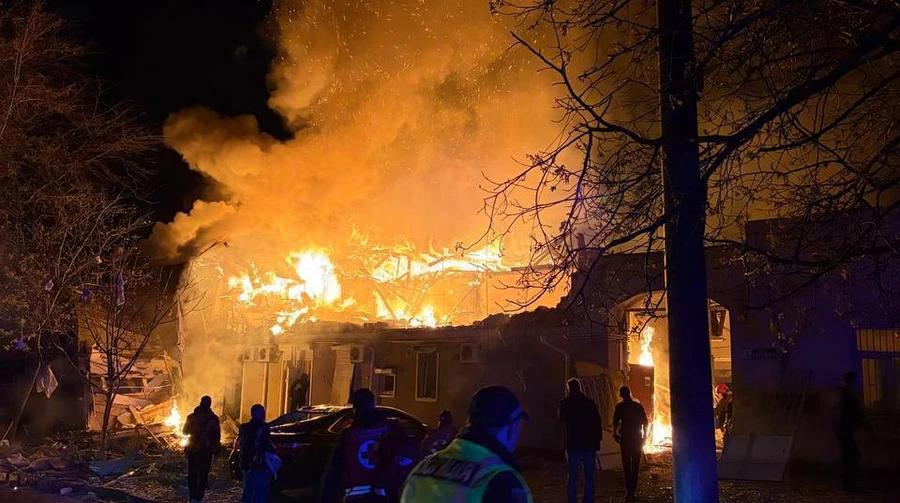
What a single message from Kyiv reveals about how this war is really being fought
The message came in just after dawn.
“Two people died, 15 people were injured. Unfortunately, this is an ordinary night in Ukraine.”
Svetlanka in Kyiv sent it with a handful of photos—one of a street where glass had been swept into careful piles, another of a burned-out car still steaming in the morning air. In the background, people were already moving again, stepping around debris the way you step around puddles after rain.
It’s easy to miss this now. Ukraine has slipped out of the center of American attention, crowded out by louder, closer noise. The war did not slow when the coverage thinned. It changed shape.
Two nights earlier, another wave of drones crossed into Ukrainian airspace, part of a pattern that now repeats often enough to feel procedural rather than exceptional¹. The numbers vary—200, 300, sometimes more—but the structure is consistent: enough volume to saturate defenses, enough persistence to guarantee that some get through.
That is what Svetlanka meant by ordinary.
A few hundred miles east, in a half-burned warehouse outside Kostiantynivka, a Ukrainian operator leans over a tablet balanced on a crate, watching a thermal feed drift across a road that no longer carries traffic. A generator hums behind him, steady but never ignored. The system flags movement. He doesn’t look away.
War used to be about where you could move. Now it is about how fast you can decide.
That shift sits underneath everything happening along the 1,200-kilometer front, where Russia continues to press and Ukraine continues to hold, neither side breaking but both adjusting constantly.