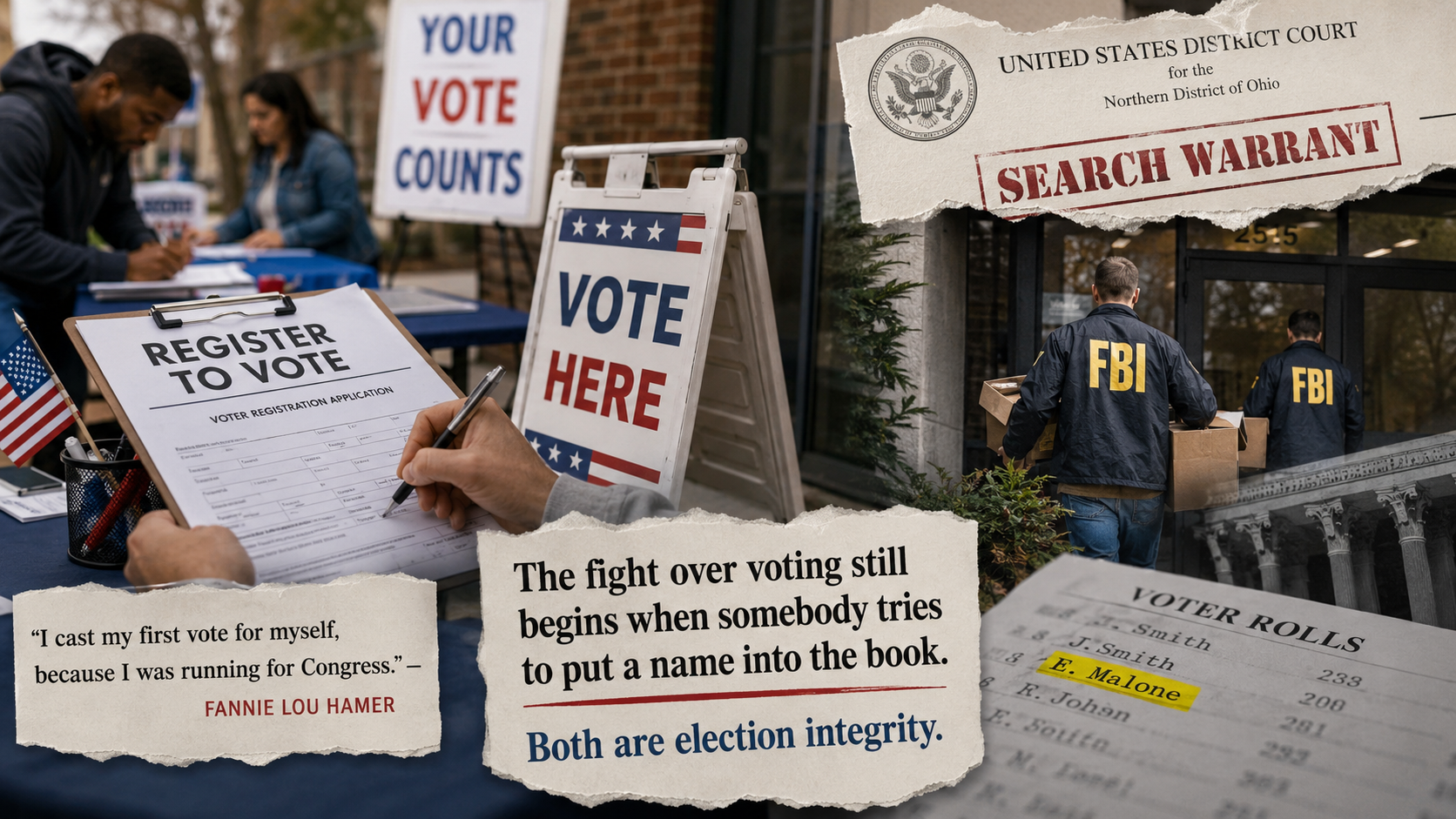
In America, the fight over voting has often begun before anybody casts a ballot. It begins with the small, ordinary act of putting a name into the book.
In 1962, Fannie Lou Hamer tried to register to vote in Mississippi. When her landlord and employer learned what she had done, he fired her and forced her from her home. Two years later, she finally cast a ballot.
“I cast my first vote for myself,” Hamer recalled, “because I was running for Congress.”¹
Ohio in 2026 is not Mississippi in 1962. It is important to say that plainly.
But the pressure point is familiar.
On June 11, FBI agents searched the Cleveland office of the Ohio Organizing Collaborative, a civil-rights group known for its voter-registration work. The Associated Press reported that agents seized documents and computer files. CBS News reported that agents also went to the homes of employees and volunteers seeking interviews.² ³
A federal judge approved the search warrant.
“Search warrants are authorized by a judge,” the Justice Department told CBS. But the affidavit that persuaded the judge remains sealed, leaving the public unable to evaluate the evidence or even determine precisely what conduct is under investigation.³
The government may have found a crime. Anyone who says otherwise is getting ahead of the facts.
There have been real problems with voter-registration forms in Ohio.
Anthony Burges had lived in his Westerville home since 1994. Yet in September 2024, he found himself testifying under oath before the Franklin County Board of Elections because a woman he had never met had been registered at his address.