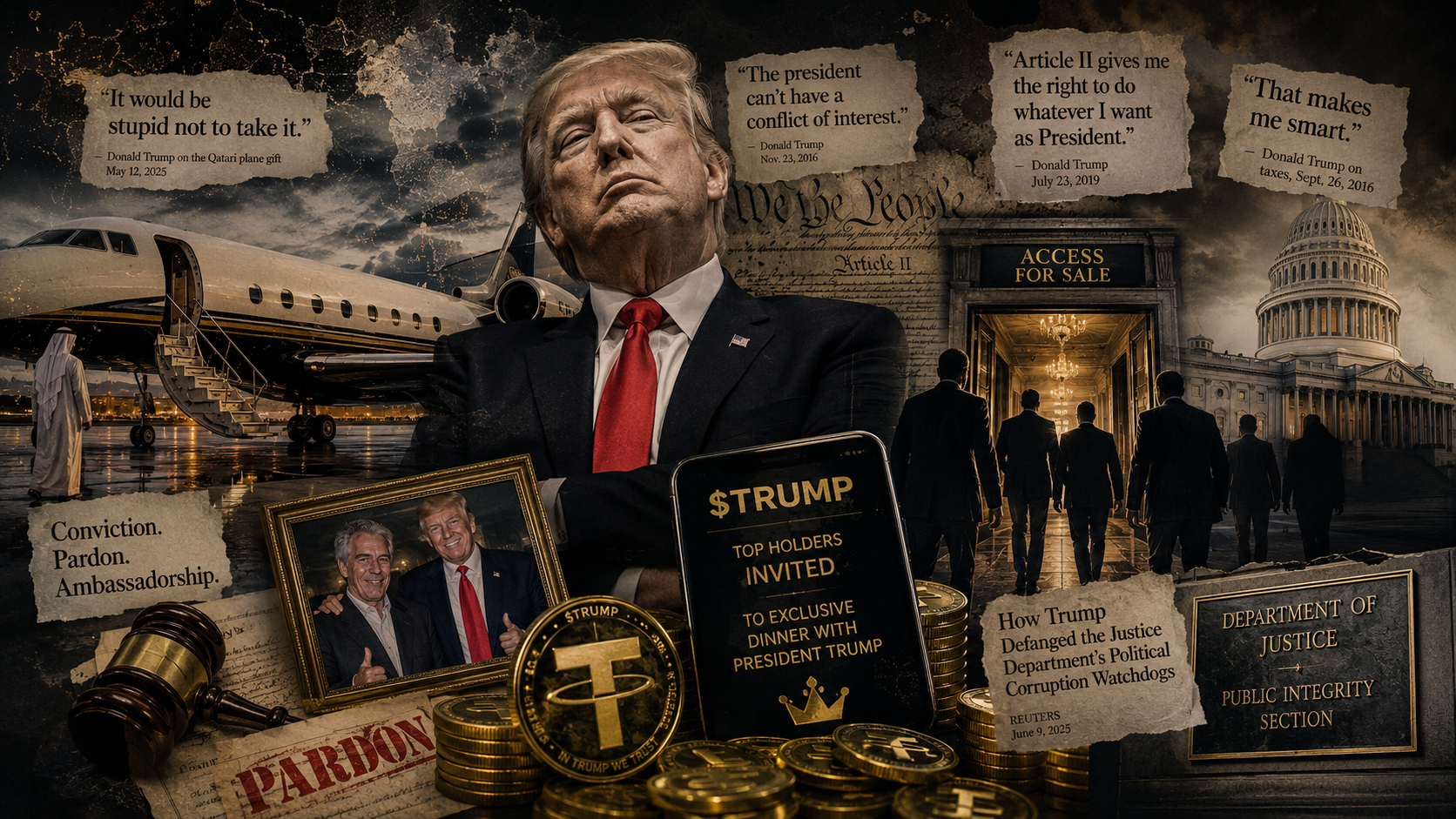
A Middle East kingdom offered President Donald Trump a $400 million flying palace, and the scandal began with the calmness of his answer. Lawyers saw the constitutional problem. Security officials saw the counterintelligence risk. Diplomats saw the obligation forming. Trump saw the bargain.
The plane was a Boeing 747-8, offered by Qatar’s royal family for Trump’s use as Air Force One, then expected to move after his presidency into the foundation built to house, brand, and glorify his legacy. A foreign government was placing something of immense value before a president whose decisions mattered to it. Trump supplied the test. It was “a great gesture.” Refusing it would be “stupid.”¹
That was the disclosure. Corruption no longer needed to sound like corruption. A foreign gift could become thrift. A conflict could become a technicality. A tax dodge could become intelligence. A private revenue stream could become national strategy. The transaction had been renamed before the public could judge it.
American politics has never been clean. Tammany Hall turned jobs into party machinery. Teapot Dome converted oil leases into payoff. Nixon treated government power as protection and revenge. Later influence markets learned softer manners: speaking fees, foundations, donor access, lobbying networks, post-presidential wealth. Trump did not invent the mingling of office, money, and favor. He made the embarrassment optional.
The difference is scale, style, and shame. Forbes estimated in September 2025 that Trump’s net worth had climbed to $7.3 billion, up from $4.3 billion the year before. Bloomberg later put the Trump family fortune at $6.8 billion and estimated that digital assets had added $1.4 billion in a year. In one span of weeks, Bloomberg reported, two crypto ventures added about $1.3 billion to the family’s wealth.²
Those are estimates, not audited receipts. They move with markets, lockups, debt, private-company assumptions, and paper valuations. The exact figure is hard to verify. The direction is not.