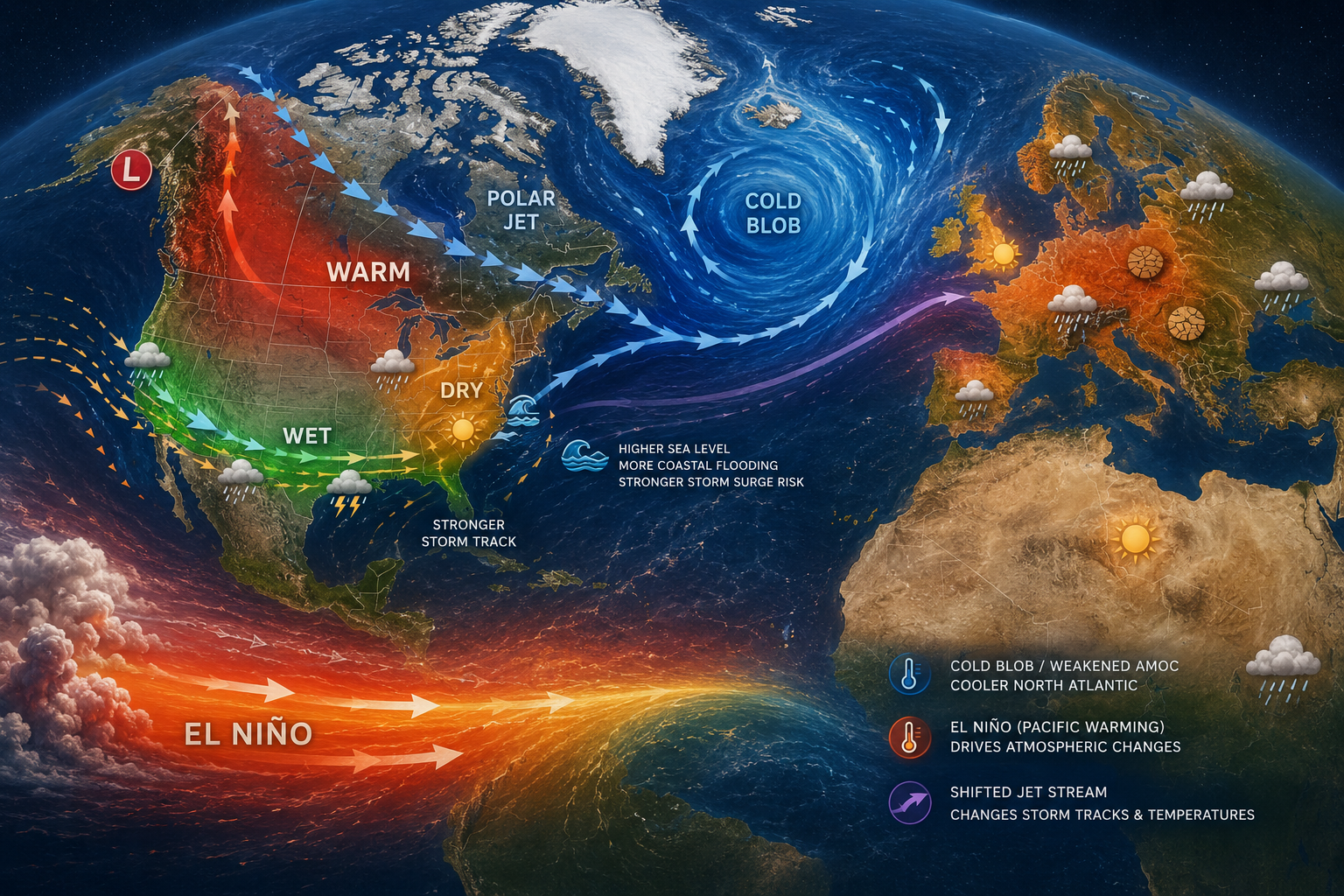
By the time the breakfast shift starts in a coastal town, a lot has already been decided. The boats have either cleared the harbor or stayed tied up. The ferry captain has checked the wind. A shopkeeper has unlocked the front door, watched the tide forecast, and hoped the next high tide stayed where it belonged.
That’s life on the North Atlantic. Weather isn’t scenery. It decides who works, who sells, who repairs a dock, who fills a dining room, and who wonders why the water seems to be reaching places it didn’t used to reach.
Now scientists are watching something far offshore that could make those ordinary calculations harder: a strange patch of cooler ocean south of Greenland and Iceland. It has a nickname that sounds almost comic — the Atlantic “cold blob” — but researchers increasingly see it as a warning light on the dashboard of the ocean.
The concern is the Atlantic Meridional Overturning Circulation, or AMOC. Think of it as part conveyor belt, part plumbing system. Warm, salty water moves north near the surface. In colder northern seas, it releases heat, becomes denser, sinks, and flows back south deep below the surface. That movement helps shape Atlantic climate, including temperature, rainfall, sea level, and the broad paths of weather systems.¹
A 2026 study in Science Advances sharpened the concern. Climate models already projected AMOC weakening this century. But when researchers used real-world observations of ocean temperature, salinity, and recent AMOC measurements to narrow the estimate, their best result was worse: about a 51 percent weakening by the end of the century, compared with about 32 percent in the standard model average. The authors wrote that this stronger projected slowdown has “key implications for future adaptation strategies.”²