Until a couple of years ago, my cooking was limited to cornflakes, spaghetti and occasional toast.
That’s not to say I didn’t eat like a king. My wife should possibly have a Michelin star. Her territory is country French cooking and traditional favorites: spectacular marinara sauce, béarnaise, Coquilles St-Jacques, chicken Parmesan with a creamy white sauce and Cornish game hens with morels.
Need I go on?
For years, I regarded cooking as an art practiced by people with some mysterious gift I didn’t possess. Barbara could taste a sauce and know what it needed. I could look into the same pan and wonder whether it was supposed to be doing that.
Then I discovered J. Kenji López-Alt.
Kenji made me believe that cooking isn’t reserved for artists. It’s science. That doesn’t mean artistry doesn’t matter. It means many of the things good cooks seem to know instinctively can also be observed, tested, measured and repeated.
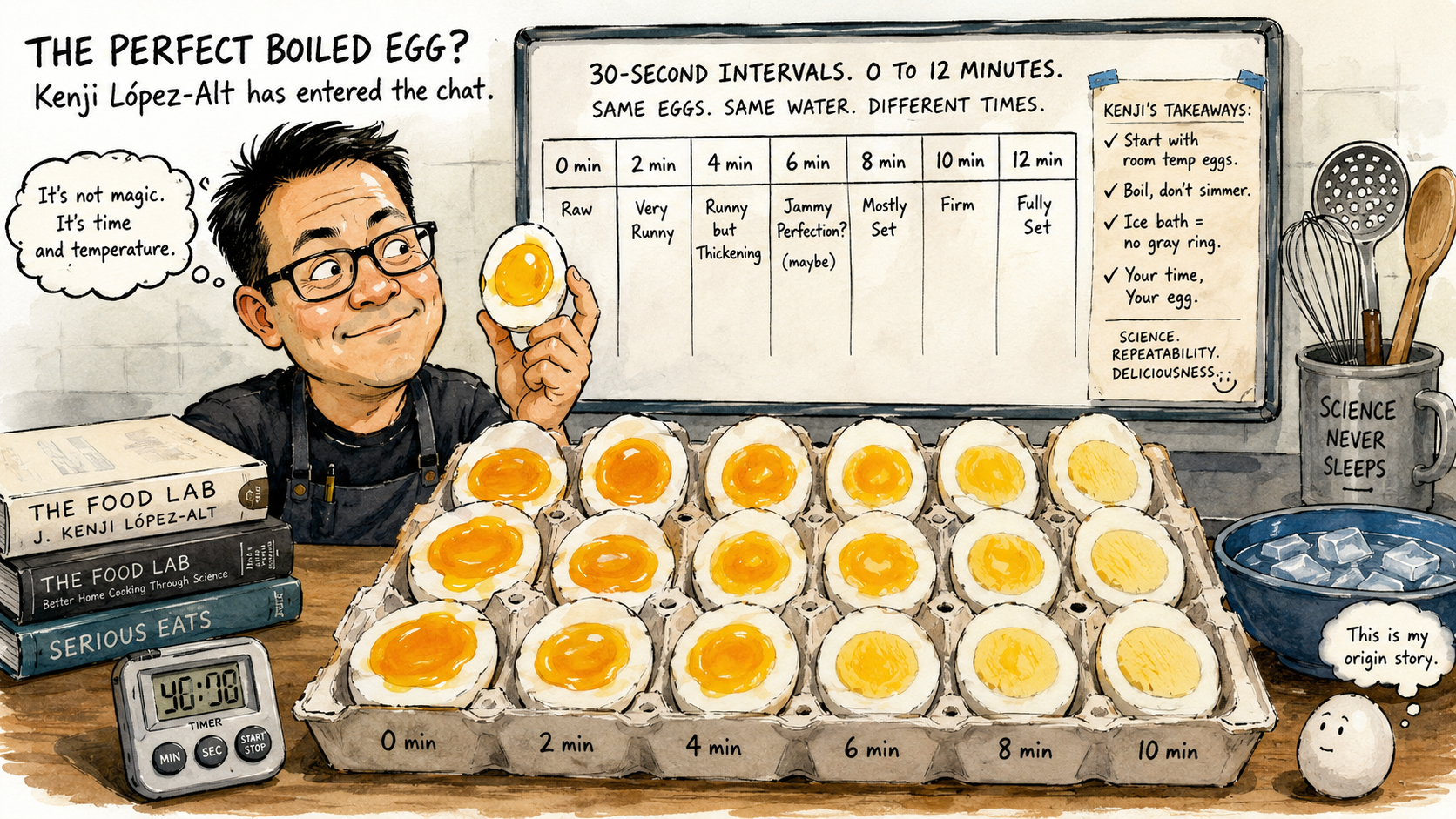
That is the approach behind his book, The Food Lab: Better Home Cooking Through Science. Kenji doesn’t simply give you a recipe. He changes one variable, then another, cooks a ridiculous number of samples and photographs the results. Why does meat brown better when it is dry? Why do some potatoes crisp while others go limp? Why do some boiled eggs peel cleanly while others surrender half their white along with the shell?¹
He approaches cooking the way an engineer might approach a bridge: form a hypothesis, control the variables, run the test and examine the result.
Then eat the evidence.
Nowhere is that method clearer than in something most of us assume we already understand: boiling an egg.