In Philadelphia, 1776, the corruption would have been understood at once. The only thing that has changed is how we respond. _____________________________________________
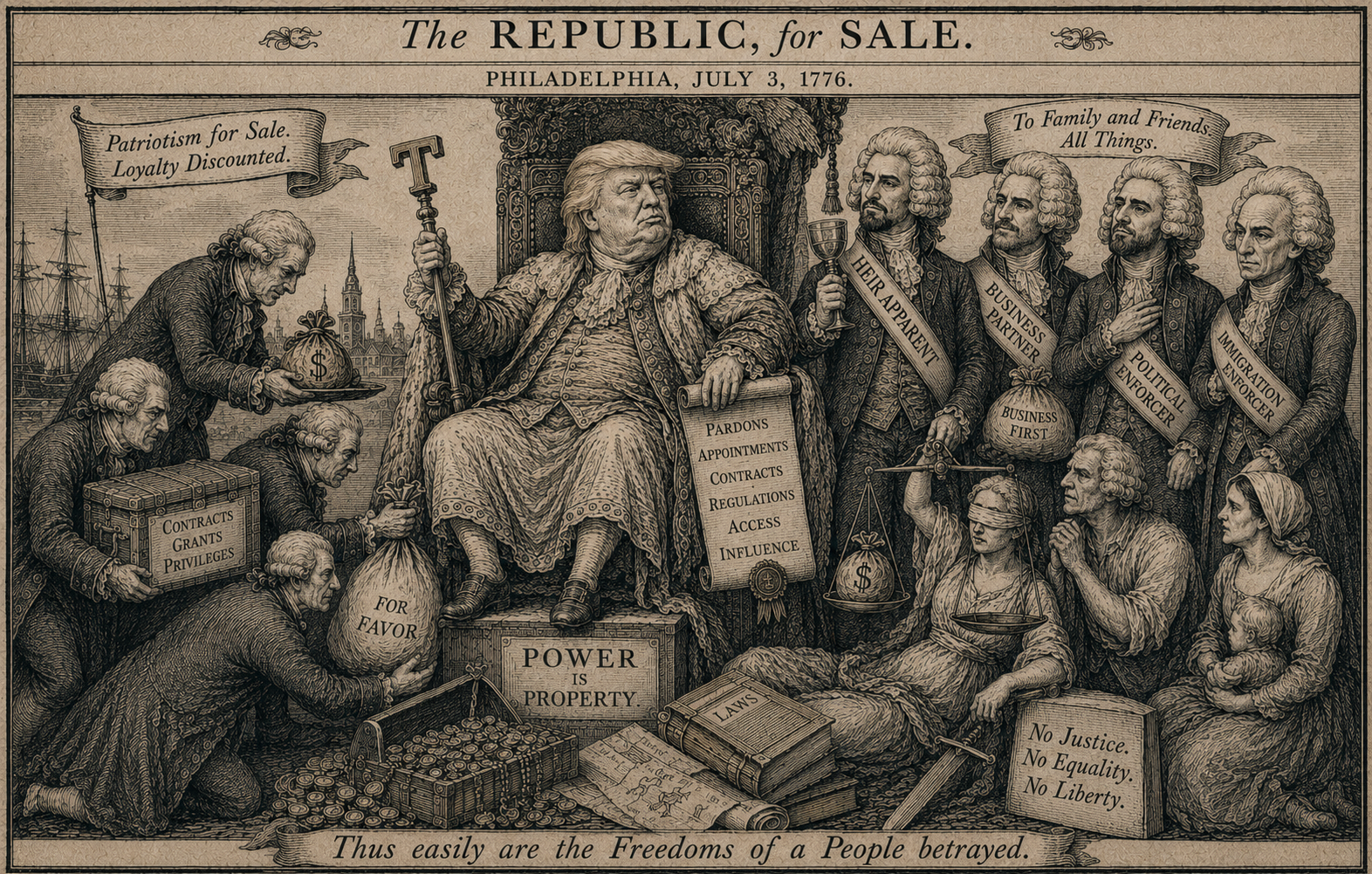
There are seasons in the affairs of republics when the greatest peril proceeds not from foreign armies, but from domestic appetite. A tyrant who appears with bayonets may yet awaken resistance. More dangerous is the magistrate who comes draped in patriotism, while quietly converting public office into private estate.
It hath long been understood among free men that public office is a sacred trust. It is not a shop. It is not an inheritance. It is not a counting-house for the enrichment of sons, friends, creditors, courtiers, or foreign adventurers.
Yet what are citizens to conclude when the ruler’s family trafficks in new coin while the ruler governs the laws of that coin? When those who seek favor know the road to influence passes through his properties, his licenses, his foundations, his name? When foreign interests need not bribe in secret because tribute may be offered in forms more elegant than a purse beneath the table?
Whether every such transaction be unlawful is not the first question. More alarming is that they should become expected.
For where access to government may be purchased by hospitality, where influence attends the spending of money at the proprietor’s inns or estates, where kindred receive honors not by distinguished merit but by blood alone, the spirit of republican government is exchanged for that very courtly system against which Americans now rebel.
Nor doth the evil terminate with wealth.
The same hand which distributes favor may likewise distribute fear. Offices once established for the impartial execution of justice become, in such circumstances, instruments whereby friends are rewarded, adversaries harassed, and independent judgment is replaced with obedient servility.
Thus the law, ordained to restrain power, becomes itself the servant of power.
History furnishes abundant instruction.
The Commonwealth of Rome did not perish because one ambitious citizen declared himself king in a single day. Rather, the ancient forms remained standing whilst their substance gradually disappeared. Offices survived. Elections continued. The Senate assembled. Yet each institution yielded a little more to the will of one man until the people discovered that they retained the appearance of liberty whilst its reality had quietly departed.
Liberty consists not merely in choosing governors, but in preventing governors from becoming masters. The division of powers was contrived precisely because the framers of free governments understood that virtue alone cannot forever restrain ambition. Institutions must accomplish what character may someday fail to do.
It is therefore no sufficient reply to say that a magistrate enjoys the affection of many citizens, or that his policies have yielded prosperity to some. The question deserving examination is of another nature altogether.
Would we willingly entrust these same powers to the next ambitious man?
If the answer be no, then prudence demands that such powers should not remain in the hands of the present one either.
For laws are not established for good men only, but likewise against those who shall hereafter prove less scrupulous.
Some imagine that corruption consists solely in the receiving of unlawful coin concealed within dark chambers. Such notions are too narrow.