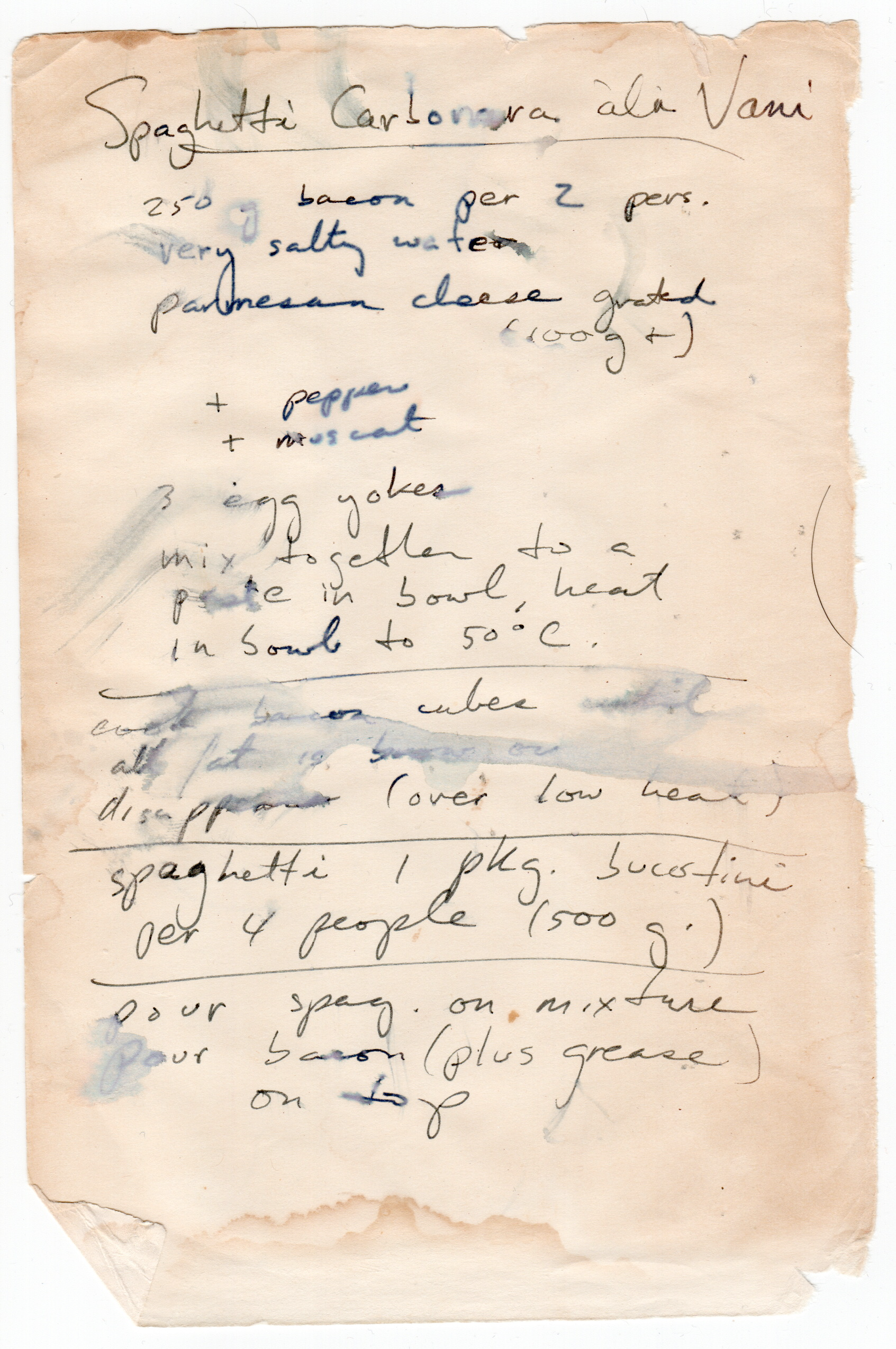
It was the first serious dish anyone ever taught me to cook.
Looking at that page now, I see more than an old recipe. It is a small record of how an Italian cook made carbonara before the modern rules surrounding it had hardened into commandments.
Today, carbonara is often presented as ancient Roman law: guanciale, Pecorino Romano, eggs, pasta and black pepper. Bacon is a violation. Parmesan is suspect. Cream is a shortcut.
Vanni used bacon, Parmesan and nutmeg. He wasn’t an American restaurant cook adapting an Italian dish for tourists. He was an Italian cooking carbonara the way he knew how.
At the time, the dish itself was still surprisingly young.
The familiar origin story says carbonara was created for American servicemen after Allied troops entered Rome in 1944. According to various versions, American bacon and powdered eggs were combined with Italian pasta, either by the soldiers themselves or by Roman cooks trying to make something from military supplies.
There is probably some truth in the larger story, but a recently rediscovered newspaper article complicates it. On August 23, 1939, a Dutch-language newspaper carried a report from Rome describing a Trastevere trattoria serving spaghetti alla carbonara. That was five years before American troops arrived.
The article provides no recipe, so it doesn’t prove that the 1939 dish was the carbonara we recognize today. It does establish that the name, and some dish attached to it, already existed. The Americans probably didn’t invent carbonara. They may have helped reshape it, popularize it and carry it home.