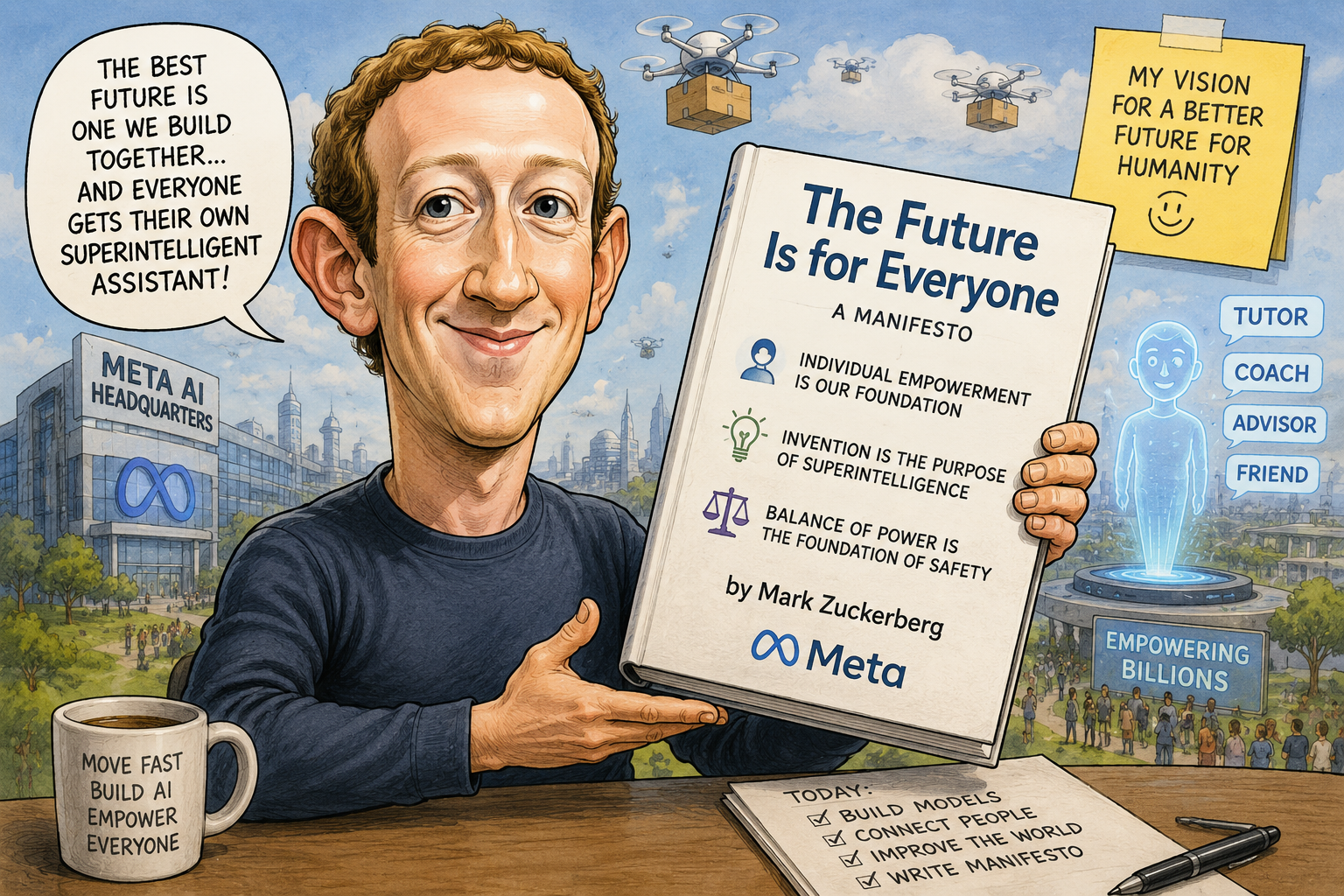
I’ve rarely agreed with Mark Zuckerberg. Much of what he has done in building his empire has seemed driven by his own interests and the growth of his company, often with remarkably little concern for the people using its products. Facebook and Instagram have spent years under criticism over privacy, addictive design and the treatment of children.¹
So when Zuckerberg publishes a manifesto describing his vision for a better future for humanity, my natural inclination is to reach for my wallet and make sure it’s still there.
I’m shocked that I find myself agreeing with him.
In The Future Is for Everyone, Zuckerberg argues that the best future for artificial intelligence is one in which increasingly powerful AI is broadly distributed rather than controlled by a handful of governments and corporations. “The best and most realistic path to building a positive AI future is by delivering superintelligence to everyone,” he writes. His philosophy rests on “individual empowerment as the source of prosperity, invention as the primary purpose of superintelligence, and balance of power as the foundation of safety.”²
Eduardo Porter, writing in Being There, sees something much darker. Zuckerberg promises a “personalized tutor and coach with a PhD in every subject” and a “superintelligent learning assistant” to help with our relationships, careers, finances and nearly everything else. Porter imagines a life in which machines increasingly save us from having to wrestle with difficult questions ourselves. “You won’t need epiphanies,” he writes.
That is a fair warning, but I don’t think it is an argument against personal AI. There is a considerable difference between asking a machine to help me understand a problem and asking it to live my life for me.